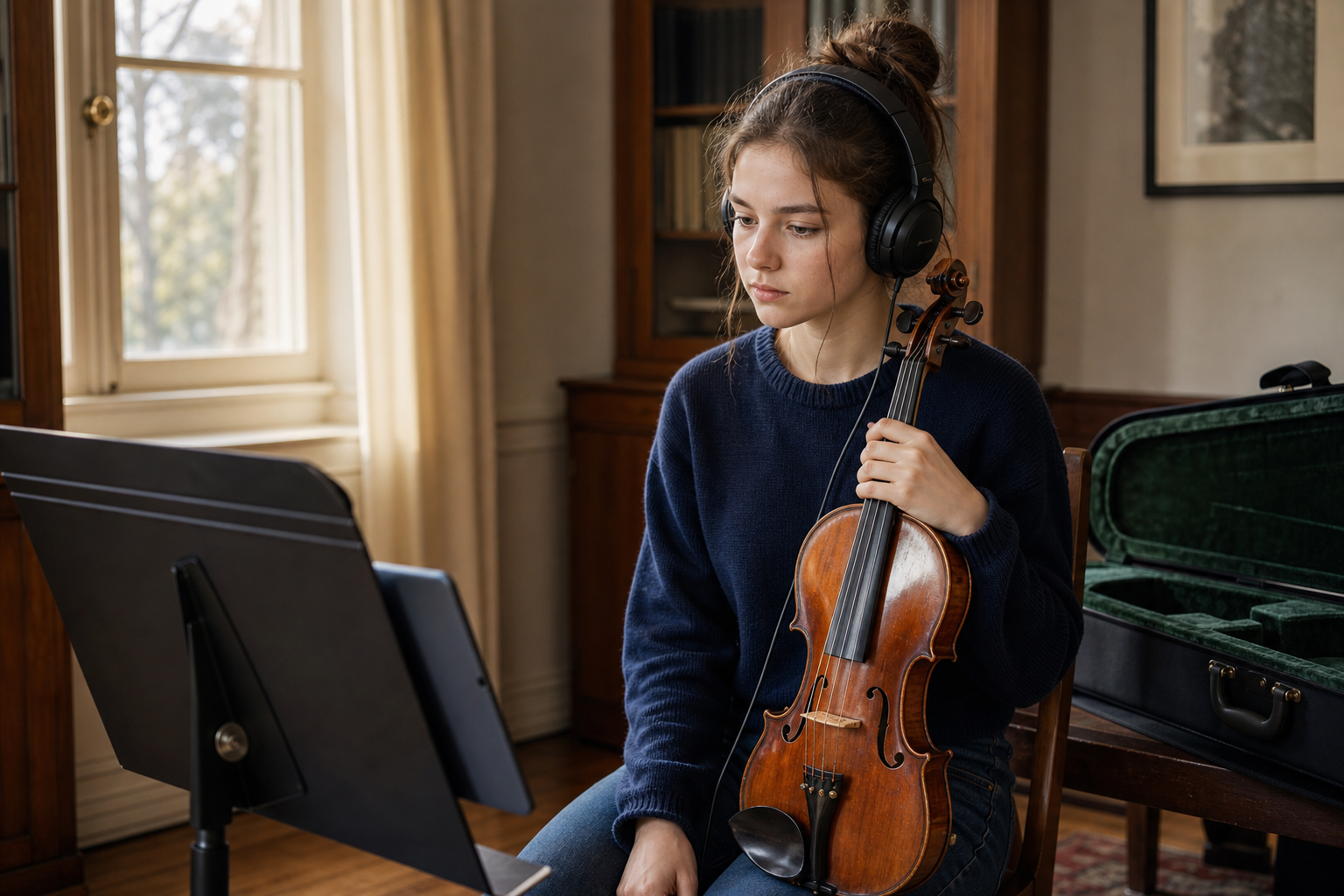
Recording review shows consistent patterns across grades and instruments. The same issues appear repeatedly, not because students are doing the same wrong things, but because some technical problems are made worse by the recording process itself.
Issue 1: Rushing under technical pressure
This is the most common rhythmic issue across grades. Students who play with a stable pulse in lessons often rush when the technical demand increases: a shift, a position change, or a fast run.
Fix: record with a metronome in the room during practice. Identify the specific passage where rushing begins and mark it. Practise that passage at 70 percent tempo until the pulse is automatic before increasing speed.
Issue 2: Intonation instability on shifts
For string players, position shifts are one of the most common intonation problems in recordings. Instability that was masked by room acoustics in a lesson becomes obvious in a dry recording setup.
Fix: isolate the shift, practise with a drone, and confirm the arrival note before connecting the passage back into tempo.
Issue 3: Inconsistent dynamic contrast
Recordings compress dynamic range. A piano that sounded clear in the room may read as nearly inaudible on playback. A forte may sound loud in person but ordinary on a phone recording.
Fix: record short samples and exaggerate dynamic contrast until the playback reads clearly.
Issue 4: Tentative endings
Final notes and chords shape the examiner’s last impression. A performance that ends with a clear, confident final note can recover some of the impression lost earlier.
Fix: practise endings separately. Do not only run pieces from the beginning.
Issue 5: Recording environment noise
Air conditioning, traffic, neighbours, and room echo are all more audible in recordings than students expect.
Fix: record at the quietest time of day, turn off constant noise sources, and test the room before the full take.
Summary
Most lost marks in recordings come from repeated musical issues, not single small slips. Timestamped feedback helps identify the issues that matter and separates musical risk from ordinary imperfection.